
Snow Plowing vs Shovelling: What Your Property Needs
 Written by Su Diab August 18, 2026 · 4 min read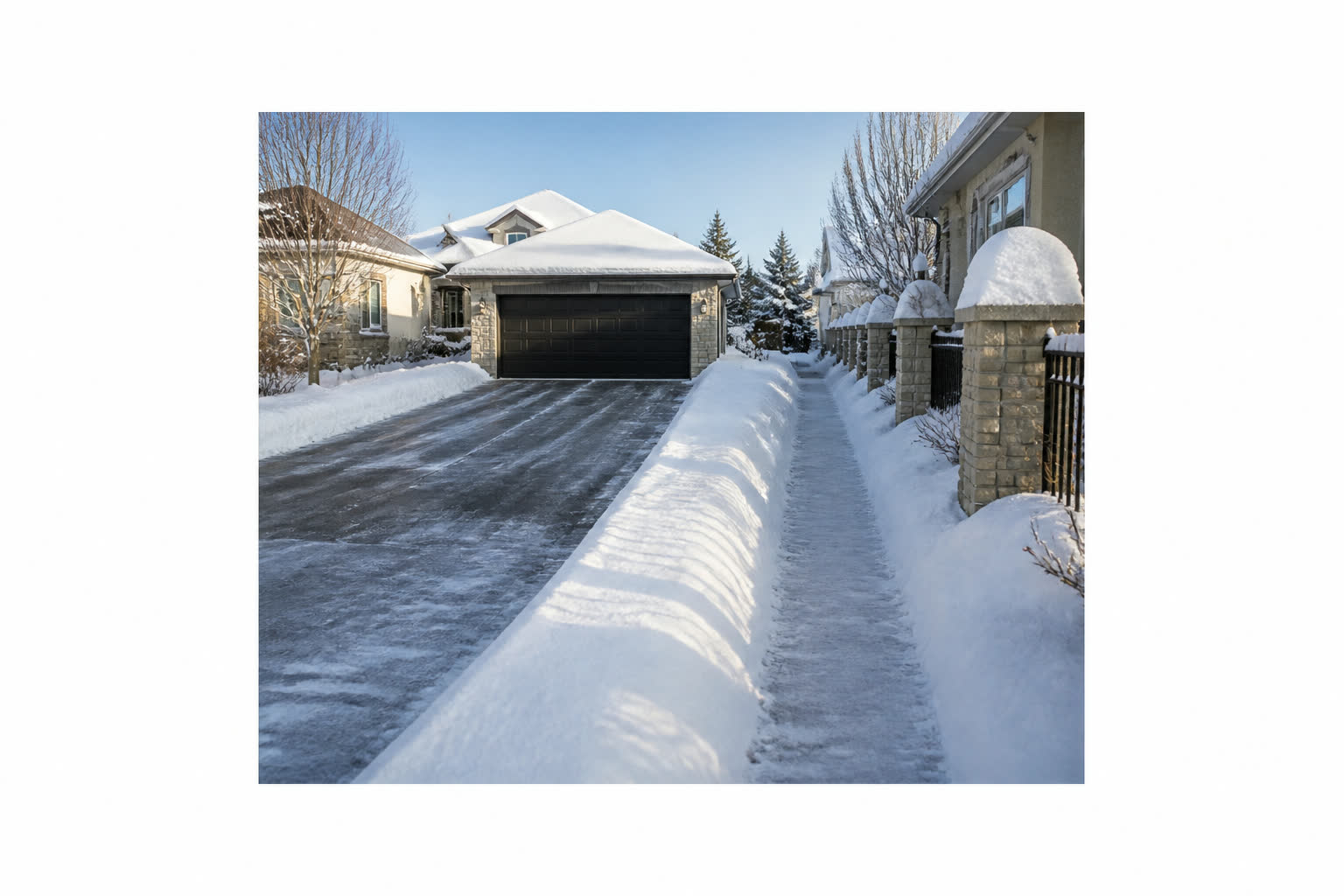
This article is for you if...
- Homeowners wondering why a quote lists both
- Property managers whose lot gets plowed but whose walkways stay icy
- Anyone comparing a cheap plow-only quote against a full-service one
Quick Answer
Plowing clears large open areas quickly with a blade on a truck or loader. Shovelling, or machine walk-behind work, handles the tight, high-risk areas a plow cannot safely reach: walkways, steps, entrances and the edges. Most Calgary properties need both, and the shovelled areas are where the liability sits.
A plow can clear a parking lot in the time it takes to shovel a single front walk. That efficiency is why plowing dominates the conversation. It is also why the parts a plow cannot reach get skipped, and why those are the parts people actually fall on.
Here is what each method is for.
What plowing does well
A blade mounted on a truck, skid steer or loader pushes snow across a surface into piles at the edge.
It is unbeatable on large, open, obstacle-free areas: driveways, drive aisles, parking areas. It is fast, it moves serious volume, and after a heavy overnight snowfall it is the only realistic way to clear a commercial lot before opening.
Its limits are physical:
- It needs room to push, so it stops where the snow has nowhere to go
- It cannot get tight to a building without risking damage
- It struggles around bollards, islands, curbs and parked cars
- It leaves a margin along edges that has to be finished another way
- It cannot do steps, at all
What shovelling does well
Hand shovelling, or a walk-behind snow blower for larger stretches, handles everything the plow cannot:
- Front walks and paths to the door
- Steps, stairs and landings
- Building entrances and the approach right up to the doors
- The public sidewalk bordering your property
- Around bollards, planters, bike racks and posts
- Accessible parking access aisles, which need clearing to full width
It is slower and more labour-intensive per square metre. It is also, on almost every property, where the highest-risk surfaces are, because those are the surfaces people walk on rather than drive on.
Why almost every property needs both
Picture a retail plaza after a plow-only visit. The lot is bare asphalt. Customers park easily. Then they step out and walk across an unclear access aisle, along an unshovelled sidewalk, and up two icy steps to the door.
The property looks serviced from the road. Every metre a person actually walked on is untouched.
That gap is where most winter incidents happen, and it is why “we plow the lot” and “the property is cleared” are not the same statement.
On a residential property the same logic applies at smaller scale. The driveway gets plowed in ninety seconds. The front walk, the steps and the public sidewalk you are legally responsible for still need doing by hand.
The Calgary complication: ice
Neither method removes ice.
A chinook can melt the top layer during the day and refreeze it overnight, leaving a plowed surface glazed and a shovelled walk slick. Clearing snow and controlling ice are two different jobs.
That is why a complete service is really three things:
- Plowing for the open areas
- Shovelling or blowing for the walkways, steps and edges
- Ice control for what forms afterwards
A quote that only includes the first is cheaper because it is a third of the work.
Reading a quote properly
Ask which method applies to which surface. Specifically:
- Is the public sidewalk included, and by which method?
- Are steps and entrances included?
- Is the accessible stall access aisle cleared to full width?
- Who finishes the plow margin along edges and around obstacles?
- Is ice control part of the price or extra?
Two quotes can both say “snow removal” and mean wildly different amounts of labour. The plowing is rarely the difference. The hand work is.
A note on doing it yourself
Plenty of Calgary homeowners shovel their own property, and that is completely reasonable. Two things worth knowing.
Timing beats effort. Clearing early, before foot traffic compacts snow into ice, takes a fraction of the work and produces a better surface. Once it is packed, you are chipping rather than shovelling.
Shovelling is genuinely strenuous. It is a heavy cardiovascular load in cold air, which is why it comes with real health warnings for people with cardiac risk factors. If that applies to you, this is not a job to push through.
Frequently asked questions
Is plowing better than shovelling? Neither is better. Plowing suits open areas, shovelling suits walkways, steps and tight spaces. Most properties need both.
Can a plow clear my sidewalk? Sometimes a small machine can, but public sidewalks, steps and entrances usually need walk-behind or hand work to reach the bare surface the bylaw requires.
Why is a plow-only quote cheaper? Because it is less work. The hand-cleared surfaces take the most labour and carry the most risk.
Does either remove ice? No. Ice control is a separate step, and in Calgary it is the one that matters most after a chinook.
What is the plow margin? The strip a blade cannot safely reach along edges, walls and around obstacles. Someone still has to clear it.
Getting both done properly
Our residential snow removal covers the driveway, walkway and the public sidewalk bordering your property, with ice control included rather than billed separately.
For businesses, commercial snow removal covers plowing the lot and the sidewalks, entrances and accessible routes, because a lot that is clear but whose walkways are not has not really been serviced.
Su Diab
Owner, Golden Angel Snow Removal
- Running Calgary snow removal crews since 2021
- 10 years experience in landscaping
- Licensed, insured and WCB covered
Su has run snow removal crews in Calgary since 2021, following ten years in the landscaping industry. He works on the properties himself and sets the standard the crews work to.